


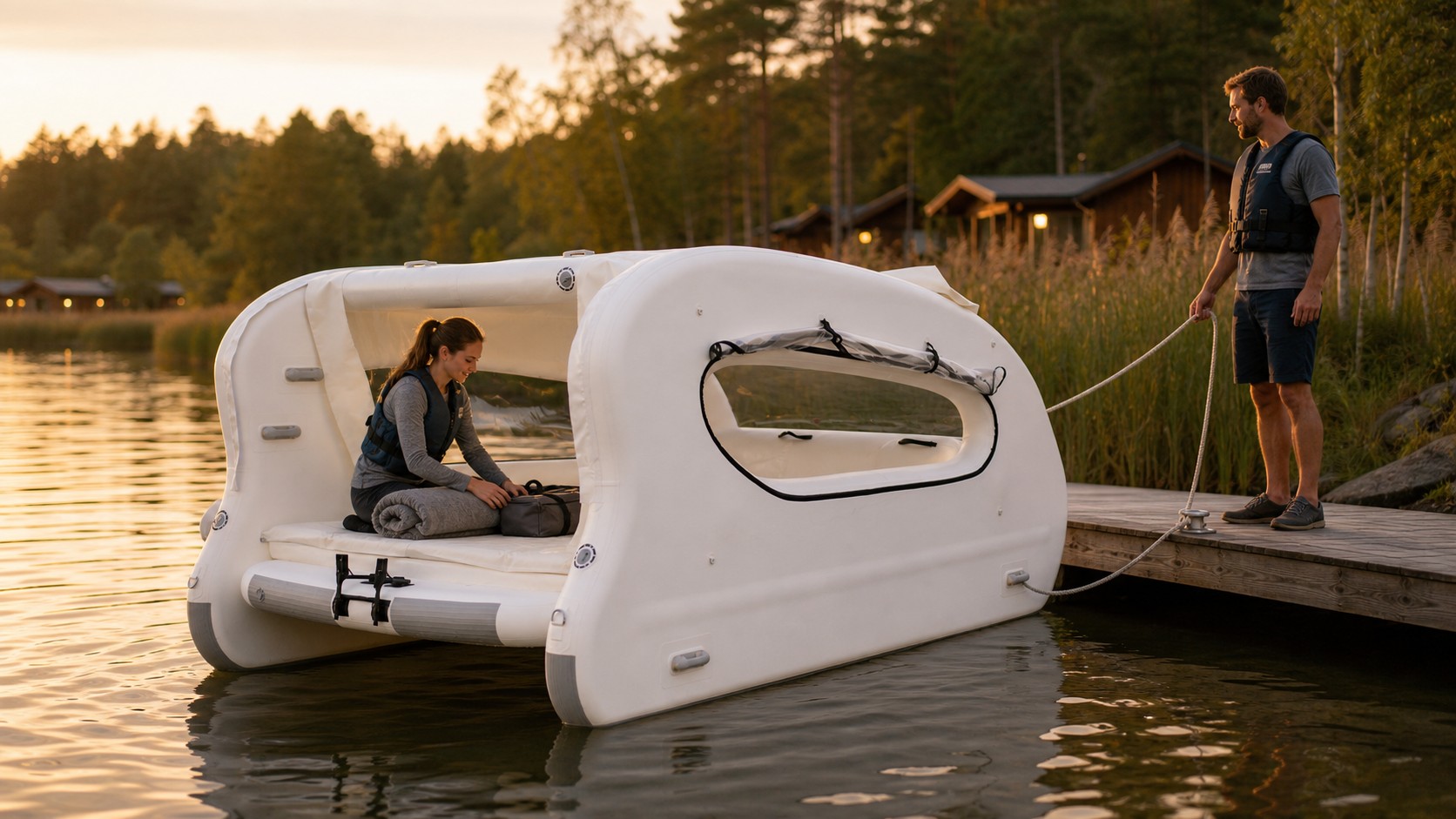
A second lifestyle view shows the inflatable houseboat secured beside a low dock in a protected resort setting.
The idea of spending a day or night on the water has usually required a conventional houseboat, a permanent marina berth, a trailer or a large storage area. Portable inflatable houseboats propose a different experience: a sheltered floating leisure space that can be deflated, packed, transported and prepared close to the launch site.
This category remains more specialized than inflatable kayaks or stand-up paddle boards, but that is exactly why it deserves careful attention in 2026. Searchers using phrases such as “inflatable houseboat,” “portable houseboat,” “inflatable house boat for camping” and “floating camping platform” are often investigating a new product concept rather than comparing familiar models. They want to understand what it is, where it can be used, how it is transported and whether it can support a credible recreational or rental program.
Google Trends can help compare relative interest between terms, but Google explains that Trends data is normalized by time and location and shown on a scale from 0 to 100. It is not an official monthly search-volume report. For a niche product, the better SEO approach is to combine the exact product phrase with the practical questions surrounding lake camping, portability, shelter, stability, mooring, setup and custom manufacturing.
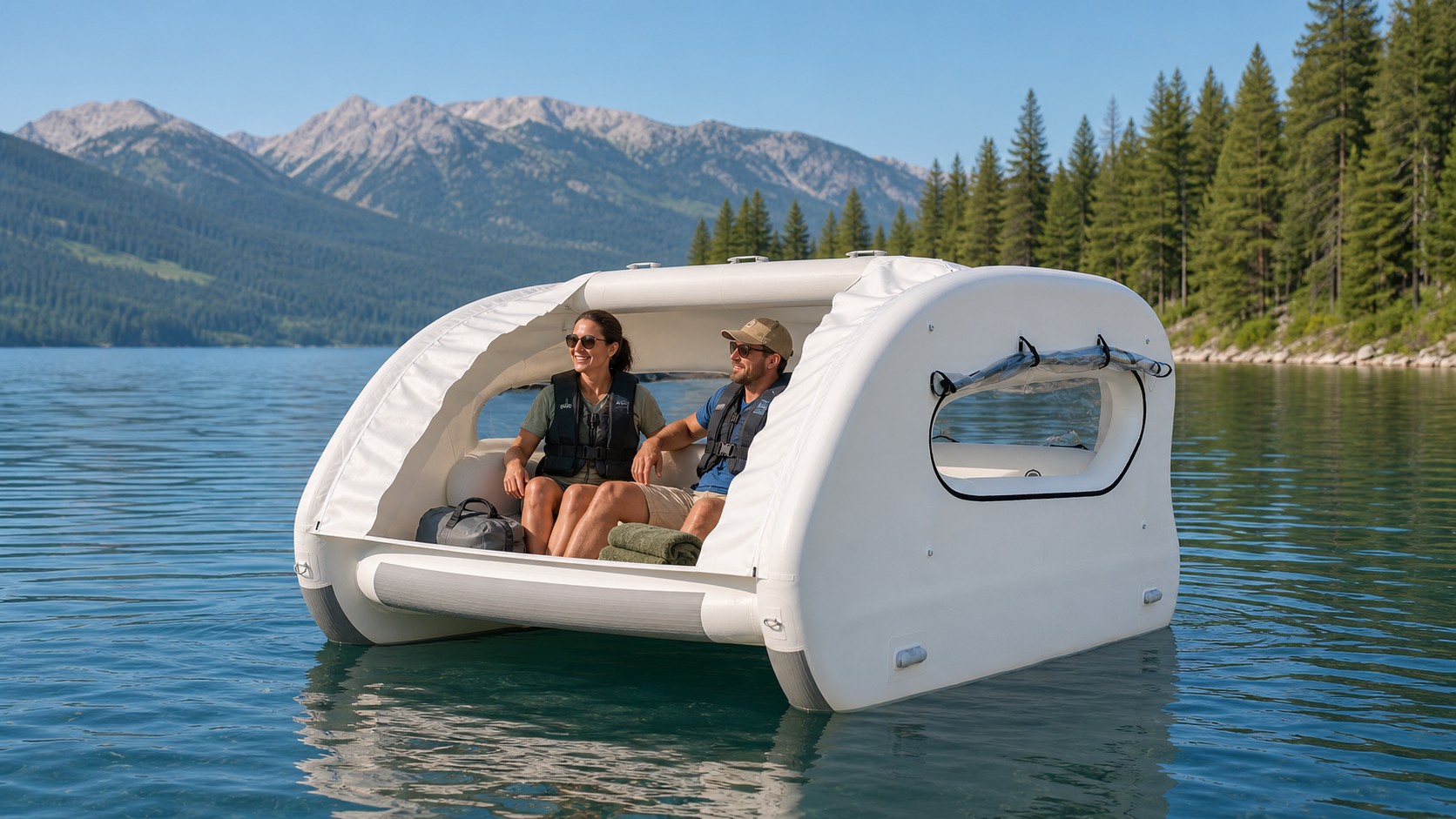
The white twin-pontoon inflatable houseboat shown in this article illustrates that opportunity. Its value is not that it imitates a large residential vessel. Its value is that it creates a protected, portable room at water level for calm-water recreation.
A portable inflatable houseboat is a recreational floating structure that combines an inflatable hull or pontoon system with a sheltered cabin-like area. Depending on the design, it may be intended for daytime lounging, fishing, protected-water camping, resort rental or another controlled leisure use.
It should not automatically be described as a floating home, offshore vessel or all-weather accommodation. Those terms imply capabilities, regulations and safety systems that may not apply. A responsible product description begins by defining the intended water, operating conditions, occupancy, setup and level of shelter.
The illustrated product uses two wide inflatable side bodies, a connecting lower structure and an arched inflatable enclosure. Large roll-up openings and clear windows provide visibility and ventilation. This arrangement creates a usable interior while preserving the visual softness and packability of an inflatable product.
The category sits between several familiar ideas:
· an inflatable boat, because it floats and may include marine fittings;
· an inflatable tent, because it creates a sheltered interior;
· a floating platform, because usable deck area is central to the experience;
· a houseboat, because the customer expects comfort, privacy and longer stays than a simple paddle craft.
That hybrid identity is commercially interesting, but it also demands careful specifications and honest communication.
The most important benefit appears before the product reaches the water. A traditional houseboat is tied to a marina, storage yard or trailer. An inflatable houseboat can be divided into a packed system that may be easier to store and transport, depending on its final dimensions and accessories.
For customers, portability can reduce several ownership barriers:
· permanent berth requirements;
· large off-season storage space;
· trailer ownership;
· difficult delivery to inland lakes;
· inflexible resort layouts;
· inability to move the product between rental locations.
However, “portable” must be supported by real package information. Buyers should receive the packed dimensions, hull weight, enclosure weight, complete package weight, number of bags, recommended carrying method and setup sequence. A product that technically deflates may still require multiple people and substantial time to move.
Brands should test the full journey: taking the bags from storage, loading a vehicle, carrying them to the launch area, inflating, assembling, launching, removing wet equipment, drying and repacking. This journey determines whether the product feels genuinely portable.
Most small watercraft are marketed around movement. A portable inflatable houseboat is better understood as a destination. The customer wants a calm place to sit, rest, read, fish, watch the shore or prepare for an overnight stay where permitted.
That changes the design priorities. Straight-line speed is usually less important than:
· usable interior area;
· balanced load distribution;
· protection from sun and light spray;
· ventilation and visibility;
· secure storage for dry bags and bedding;
· convenient entry and exit;
· dependable mooring points;
· easy cleaning and drying.
This does not mean movement is irrelevant. The product still needs a clear operating plan for reaching the intended location. If the design accepts a propulsion system, the compatible motor, maximum power, mounting arrangement, battery location, steering method and local registration requirements must be confirmed separately. A visible bracket should never be treated as permission to install any motor.
The illustrated houseboat uses two inflated side bodies separated by a central opening and connected structure. A twin-pontoon layout can create a broad stance and a more room-like interior than a narrow kayak hull. The useful result depends on pontoon diameter, spacing, shape, pressure, floor construction and load distribution.
Stability should not be described with one word. Buyers need to understand:
· initial stability while passengers sit or move slowly;
· behavior when weight shifts toward one side;
· freeboard with the recommended payload;
· response to small wakes and wind;
· how mooring loads reach reinforced points;
· whether entry from shore or dock changes the balance.
Prototype testing should include realistic people, bedding, bags, battery or other intended equipment. An empty craft can appear stable while behaving differently when the interior is loaded unevenly. A clear manual should show where heavy items belong and warn users against climbing onto the roof or concentrating weight on unsupported areas.
The arched enclosure is the feature that makes the product feel like a houseboat rather than an open raft. It can provide shade, visual privacy and protection from light spray. Large front openings and side windows make the interior feel less confined and allow the user to monitor the surrounding water.
The enclosure also creates design questions:
· How are clear window panels attached and rolled?
· Which openings remain available for cross-ventilation?
· How is condensation reduced?
· Can rainwater collect on the canopy?
· How are zippers, hook-and-loop fasteners or buckles protected?
· What parts need to be dry before packing?
· Which surfaces are designed to carry load, and which are not?
Marketing should avoid calling a soft enclosure storm-proof, completely waterproof or suitable for every season unless those claims have been verified under defined test conditions. A sheltered cabin is a comfort feature, not permission to ignore weather.
Clear panels do more than improve appearance. They allow occupants to see other craft, the shoreline and changing weather. Large openings can also support ventilation and provide an easier route in and out.
For private-label development, brands should define the window shape, clear material, border reinforcement, opening direction, fastening points and privacy option. The user should be able to roll and secure a panel without it falling into the water or blocking a handle.
The exit path must remain understandable when bags or bedding are inside. Equipment should not obstruct the main opening. If the product is intended for overnight use, internal organization becomes even more important because darkness and condensation can make a cluttered space difficult to navigate.
A portable houseboat spends much of its time stopped. Mooring is therefore not an accessory detail; it is part of the main function. The correct solution depends on water depth, bottom type, shoreline rules, wind exposure and local regulations.
Operational guidance for conventional houseboats emphasizes securing the craft, monitoring changing weather and checking lines as water levels or conditions change. The same cautious mindset is appropriate here, even though an inflatable product has different dimensions and loads.
A sourcing brief should identify:
· reinforced D-rings or mooring points;
· intended line angles and load paths;
· suitable rope diameter and length;
· attachment method at a dock or shoreline;
· protection against abrasion;
· whether an anchor is included or supplied separately;
· prohibited attachment points;
· safe boarding from a dock, beach or shallow water.
Users should never tie to a window frame, canopy tube or handle that was not designed for mooring. The manual should use diagrams to show the approved points.
The transition between land and water is where many products feel inconvenient. A tall side wall can improve shelter but make boarding difficult. A low opening can simplify access but allow more spray. The product shown here uses an open end between two inflated sides and a cross tube, creating a clear area that can face a beach or low dock.
Brands should test boarding with the actual customer group. A resort product may be used by first-time visitors. A fishing version may carry rods and a cooler. A camping version may carry bulky dry bags. Handles, non-slip surfaces, step positions and instructions should match those uses.
The craft should be held securely during boarding, with occupants entering one at a time and keeping weight near the center. Product imagery should demonstrate that behavior rather than showing people standing on unsupported edges or sitting on top of the cabin.
The phrase “inflatable house boat for camping” suggests overnight use, but a safe overnight program requires more than a comfortable interior. The operator must consider local rules, weather, lighting, communication, ventilation, sanitation, water access, emergency planning and secure mooring.
For B2B buyers, the intended use should be classified clearly:
· daytime leisure shelter;
· short-duration floating lounge;
· fishing or wildlife-viewing platform;
· supervised resort rental;
· overnight camping in designated protected water;
· another controlled commercial application.
The manual, packaging and sales page should match the approved category. If overnight use has not been evaluated, the product should not be marketed as sleeping accommodation simply because bedding fits inside.
An inflatable houseboat can create a distinctive rental experience for lakeside resorts, campgrounds and outdoor-tourism operators. The product is visually memorable and may be moved or stored more easily than a permanent floating cabin.
Commercial buyers will look beyond the first photograph. They need to know how staff will:
· inspect the product before each use;
· record inflation pressure and air retention;
· clean clear panels and interior surfaces;
· dry the enclosure after rain or condensation;
· manage mooring lines and permitted zones;
· explain loading and prohibited behavior;
· store the product during high wind or off-season periods;
· identify damage and isolate a unit from service;
· obtain repair materials and replacement parts.
A successful rental model combines product design with a repeatable operating procedure. Easy-to-read labels, numbered assembly components and a short illustrated checklist can be as valuable as an additional accessory.
An inflatable houseboat brings together large air structures, clear window material, floor or cross-member elements and many attachment points. Each interface requires attention.
Buyers should clarify:
· base fabric and coating specification;
· internal construction used for rigid areas;
· chamber count and valve layout;
· rail or seam joining method;
· reinforcement around openings, handles and D-rings;
· window material, thickness and cold-fold behavior;
· abrasion protection at contact areas;
· recommended and maximum working pressure;
· repair method for the hull and clear panels;
· UV, temperature and storage limitations.
The largest number is not automatically the best specification. Pressure, thickness and material weight must work as a system. Higher pressure can improve rigidity only when the fabric, seams, valves and geometry are designed for it.
A productive OEM or ODM project begins with a detailed use case. Before requesting a quotation, brands, distributors and resort buyers should define:
· target market and customer group;
· daytime or approved overnight use;
· intended water environment and operating limits;
· target occupancy and recommended total payload;
· overall dimensions and packed-size target;
· number and location of air chambers;
· floor, pontoon and enclosure construction;
· window and roll-up opening configuration;
· entry, handles, non-slip and storage layout;
· approved mooring and lifting points;
· propulsion requirements, if any;
· accessory, pump, repair kit and bag requirements;
· graphics, packaging, labels and manual languages;
· prototype test plan and production inspection standard.
Wassersporte.com can customize inflatable products according to customer requirements, including size, color, shape and graphics. For a houseboat project, the customer and manufacturer should also agree on chamber layout, windows, openings, reinforced fittings and the intended operating environment before sampling.
Large inflatable products need systematic inspection because small alignment errors can affect windows, openings, floor fit and the way the houseboat sits on the water. Quality control should follow the product through production rather than depending only on a final visual check.
Our products are inspected after each production process and receive a complete final inspection before packing. Depending on the approved specification, an inflatable houseboat inspection plan can include:
· incoming material and cutting verification;
· chamber, seam and rail inspection;
· valve and air-retention testing;
· dimension, pressure and symmetry checks;
· window clarity, bonding and fastening inspection;
· floor, canopy and opening assembly;
· handle, D-ring and mooring-point verification;
· accessory and packaging completeness;
· final inflated appearance and stability review.
This process supports the one-year warranty and gives private-label customers a clearer approval record.
An attractive cabin can make the product feel like a room, but it remains a floating recreational product. Users should wear appropriate life jackets, monitor weather, carry communication equipment and leave a float plan with a responsible person. The U.S. Coast Guard recommends wearing an approved life jacket on the water and explains that float plans are useful for many small-craft users, not only owners of large boats.
Registration, navigation lights, propulsion rules, anchoring restrictions and overnight permissions vary by jurisdiction. The seller should not promise universal legality. The correct instruction is to check the intended waterway and local authority before use.
The manual should also cover inflation, pressure, valves, chamber checks, loading, boarding, ventilation, sharp objects, mooring, emergency exit, weather limits, cleaning, complete drying and storage. Never operate or occupy the product in conditions outside the approved specification.
The portable inflatable houseboat is not a replacement for every conventional houseboat. It serves a different customer: someone seeking a sheltered, transportable and visually distinctive calm-water experience without committing to a permanent floating structure.
For consumers, the appeal is a private room close to the water. For resorts and rental companies, it is a movable experience product. For brands and distributors, it is a chance to develop a differentiated category around water camping, leisure and modular customization.
Success depends on disciplined product definition. Portability needs real packed dimensions. Stability needs realistic load testing. Shelter needs ventilation and weather limits. Overnight use needs an operational plan and local permission. Custom manufacturing needs an approved technical specification and repeatable quality control.
When those pieces work together, the inflatable houseboat becomes more than an unusual image. It becomes a credible product story—and a strong long-tail SEO topic for buyers searching for the next step beyond kayaks, paddle boards and ordinary floating platforms.
An inflatable houseboat is a recreational floating structure that combines inflatable pontoons or a hull with a sheltered cabin-like area. Depending on the approved design, it may support daytime leisure, fishing, protected-water camping or rental use.
Only when the specific product has been designed and approved for that use, conditions are suitable and local rules permit overnight occupancy. Secure mooring, ventilation, weather planning, lighting, communication and emergency procedures must also be considered.
Stability depends on pontoon geometry, width, pressure, floor construction, payload and weight distribution. Buyers should review the recommended operating load and real prototype tests rather than relying only on the word “stable.”
Only if the model has an approved motor mount and the manufacturer specifies compatible motor type, power, weight, battery placement and steering. Local registration and navigation rules may also apply.
Check inflation pressure, air chambers, valves, seams, windows, openings, handles, mooring points, lines, floor or cross members and all required safety equipment. Do not use the product if damage or abnormal air loss is found.
Yes. We can customize the size, color, shape and graphics according to your requirements. Chamber layout, windows, openings, reinforced fittings and accessories can also be developed according to the approved technical specification.
We are one of the leading manufacturers in the industry, with advanced production technology, strict quality control and a one-year warranty.
Every product is inspected after each production process and receives a complete final inspection before packing.
Address 732 households, No. 55 Feixian Road, Shinan District, Qingdao City, Shandong Province
E-mail zachary@wassersporte.com

