


Inflatable SUP Pre-Shipment Inspection Checklist: What OEM Buyers Should Check
Your custom inflatable paddle boards have finished production.
The graphics look correct in the photographs.
The supplier says the order is ready.
Shipping arrangements are being discussed.
But before approving shipment, there is one important question:
How do you know the finished inflatable SUP boards actually match the products you ordered?
For wholesale buyers, retailers and private label brands, pre-shipment inspection provides an opportunity to identify problems before the products leave the manufacturing location.
However, inspecting an inflatable paddle board involves more than checking its appearance.
Air retention, rail construction, valve performance, dimensions, accessories and packaging all deserve attention.
This guide explains what buyers should check before approving an OEM inflatable SUP shipment.
1. What Is Inflatable SUP Pre-Shipment Inspection?
Pre-shipment inspection is a quality review carried out before an order is dispatched.
Its purpose is to verify whether the finished products meet the agreed specifications and acceptance requirements.
For inflatable paddle boards, this may include:
Product identity and dimensions.
Construction workmanship.
Air-retention performance.
Valve installation.
Graphics and EVA deck pads.
Fin systems and attachments.
Accessory configuration.
Packaging and labeling.
The inspection may be performed by the supplier's quality team, a buyer-appointed representative or an independent inspection company.
However, the scope and sampling method should be agreed before the inspection begins.
A pre-shipment inspection is not a substitute for appropriate quality control throughout manufacturing.
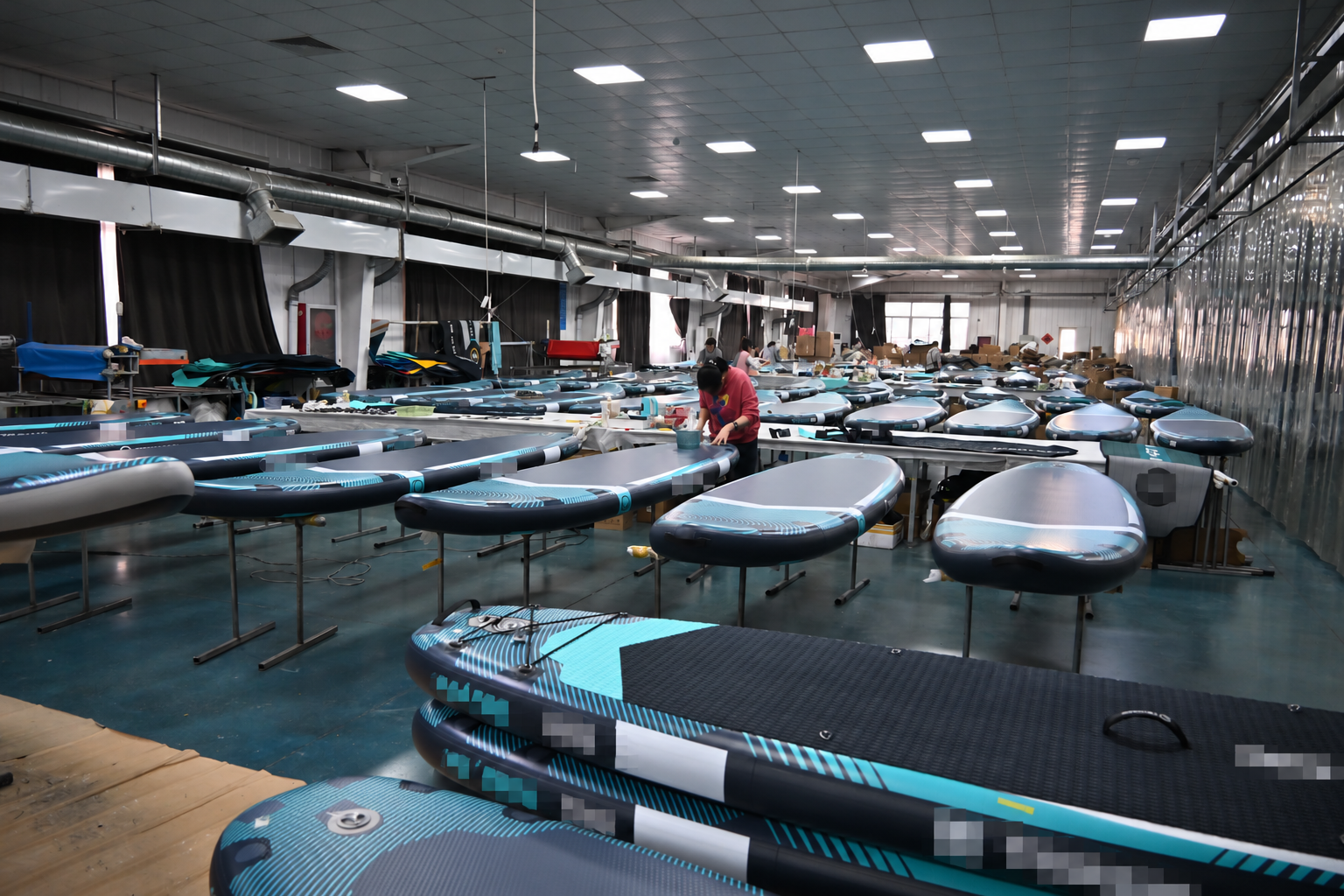
2. Start With the Approved SUP Specification
The most important inspection reference is not a promotional catalog.
It is the product specification approved for the actual order.
Before inspecting the finished inflatable SUP, prepare the relevant documents.
These may include:
Approved physical sample.
Technical specification.
Board dimensions.
Construction requirements.
Final artwork.
Material and component list.
Accessory configuration.
Packaging requirements.
Inspection criteria.
Without clear reference documents, an inspector may identify obvious damage but miss important differences from the intended product.
For example, a finished paddle board may look attractive while using a different fin system or EVA layout from the approved sample.
Product acceptance should be based on what was agreed, not what merely looks acceptable.
3. Verify the Correct Models and Order Quantities
Wholesale inflatable paddle board orders often contain several colors, dimensions or product configurations.
The first inspection step should confirm that the finished products match the purchase order.
Check the model identification.
Confirm the board dimensions and color variations.
Review the quantities assigned to each SKU.
Check whether the accessories and packaging correspond to the correct model.
A supplier may manufacture the correct total number of SUP boards but allocate the wrong quantities between different designs.
This can create problems for retailers expecting specific stock combinations.
Quantity and assortment verification should therefore be included in the pre-shipment checklist.
4. Inspect the Inflated SUP Shape and Dimensions
An inflatable paddle board should be inspected in its inflated condition when evaluating its structural shape.
The inspector can compare the finished board with its approved dimensions and reference sample.
Important observations include:
Overall length.
Maximum width.
Board thickness.
Nose and tail shape.
Rail symmetry.
Surface alignment.
Visible twisting or deformation.
The board should be inflated according to the approved testing procedure.
Dimensional measurements should use the agreed method and tolerances.
Small measurement differences can occur because of inflation conditions and measuring techniques.
This is why buyers should establish acceptance criteria before manufacturing rather than inventing tolerances during the final inspection.
5. Check SUP Air Retention and Pressure Records
Air retention is one of the most important quality characteristics of an inflatable SUP.
A board that cannot maintain appropriate pressure may become unsuitable for normal use.
Before shipment, buyers should confirm how the supplier verifies airtightness.
Relevant information may include:
Test pressure.
Testing duration.
Measurement equipment.
Ambient temperature.
Board identification.
Recorded results.
Acceptance criteria.
A pressure reading should be interpreted with consideration for temperature changes.
The exact testing conditions must match the approved product requirements.
Buyers should also distinguish between reviewing the manufacturer's existing air-retention records and conducting additional tests on randomly selected boards.
These are related but different activities.
A brief visual inspection cannot establish long-term air retention.
6. Inspect the Valve and Rail Construction
The inflation valve and rail seams are important parts of the inflatable paddle board's airtight structure.
During inspection, examine the valve installation and surrounding material.
Look for visible damage, unusual gaps or poorly finished areas.
The valve should operate correctly according to the product's design.
The rails should also be inspected for workmanship consistency.
Potential concerns include:
Visible seam openings.
Unexpected material lifting.
Poorly finished overlaps.
Uneven reinforcement.
Abnormal wrinkles.
Suspected air leakage.
The inspection criteria should reflect whether the approved construction uses welded joints, adhesive bonding or a combination of methods.
Visual inspection alone cannot prove the internal strength of every structural connection.
Any suspected structural defect should be investigated before shipment approval.
7. Check EVA Deck Pads and Installed Components
An inflatable SUP may pass its air-retention test while still having visible finishing or assembly problems.
The EVA deck pad should match the approved layout.
Inspect the pad's positioning, surface appearance and edge adhesion.
Check whether the handle is correctly installed.
Review the position and workmanship of the specified deck attachments.
The inspector should also confirm that installed components correspond to the approved sample.
A poorly positioned EVA pad or incorrectly installed fitting can affect the finished product's appearance and usability.
For private label paddle board brands, consistent finishing is important because customers expect products of the same model to look and function consistently.
8. Verify Custom Graphics and Branding
Custom inflatable SUP graphics are an important part of product identity.
Before shipment, compare the finished board with the approved artwork.
Check:
Logo position.
Graphic orientation.
Color consistency.
Printing alignment.
Deck graphics.
Rail graphics.
Bottom graphics.
Brand identification.
The final product should be evaluated using the agreed artwork and physical color references where applicable.
A digital rendering alone may not accurately represent the appearance of printed PVC.
Inspectors should distinguish between acceptable manufacturing variation and defects that fail the agreed appearance requirements.
For private label projects, incorrect branding can make otherwise functional products unsuitable for their intended retail presentation.
9. Test Fin Compatibility and Accessory Configuration
The included accessories should be inspected as part of the complete inflatable SUP package.
A board may be manufactured correctly but arrive with an incompatible fin or incorrect pump adapter.
Where appropriate, the inspection should include functional compatibility checks.
Confirm that:
The fin fits its intended fin box.
The paddle assembles and adjusts correctly.
The pump connection matches the SUP valve.
The carry bag fits the approved product package.
The supplied accessories match the agreed configuration.
Different accessory versions may look similar in photographs.
For wholesale orders, the inspector should therefore compare actual components with the approved specification rather than relying only on their general appearance.
10. Inspect Retail Packaging and Carton Information
The final inspection should also cover packaging.
Retail cartons, product identification and accessory completeness directly affect how the finished inflatable SUP reaches the customer.
Check the approved packaging layout.
Verify product identification and required labels.
Confirm that instruction materials are included where specified.
Review the packing list and carton markings.
Examine the condition of the packaging.
For shipments containing several SUP models, confirm that carton identification corresponds to the correct product.
Packaging errors can create warehouse and retail problems even when the paddle board itself is correctly manufactured.
Destination-market labeling and documentation requirements should be checked separately against applicable rules.
11. Understand AQL Sampling and Its Limitations
Many international product inspections use AQL-based sampling plans.
AQL stands for Acceptance Quality Limit.
A sampling plan defines how many units will be selected and how the inspection results will be evaluated.
Defects are commonly classified according to their seriousness.
Critical defects involve unacceptable safety or other critical risks.
Major defects can significantly affect function or product acceptance.
Minor defects generally involve less significant deviations.
The exact classification and acceptance rules should be established for the order.
However, sampling inspection has limitations.
Inspecting a sample does not prove that every inflatable SUP in the shipment is free from defects.
For important functional characteristics such as air retention, buyers should separately confirm the manufacturer's agreed testing coverage and review the available records.
Sampling inspections and production quality-control tests should work together.
12. What Happens if the Inspection Finds Defects?
Finding a defect does not automatically explain its cause.
The inspection report should identify the problem and record appropriate supporting evidence.
For significant issues, the buyer and supplier should determine whether the affected products need to be isolated, repaired, replaced or investigated further.
Corrective actions should be documented.
If rework is permitted, the repaired products should be checked again according to the relevant requirements.
A failed inspection should not be converted into approval simply because shipment has already been arranged.
The final decision should follow the agreed acceptance procedure.
If a proposed correction changes the original product specification, the buyer should review and approve that change before release.
13. Should You Use a Third-Party SUP Inspection Company?
An independent inspection company can provide additional verification when the buyer cannot visit the manufacturing location.
Third-party inspectors may review the completed products, select samples and document findings against the agreed inspection checklist.
This can be useful for:
First-time supplier relationships.
Large wholesale orders.
Complex private label projects.
Orders with several product configurations.
Previous quality concerns.
However, an independent inspection is only as useful as its agreed scope.
The inspection company should understand the relevant inflatable SUP requirements.
Specialized tests may require additional equipment, time or separate laboratory procedures.
Before booking an inspection, confirm what the inspector will actually test and what evidence will appear in the final report.
14. What Should a SUP Inspection Report Include?
A useful inspection report should clearly identify the order and inspected products.
Relevant information may include:
Supplier and order reference.
Inspection date and location.
Product models.
Order quantities.
Sampling method.
Inspection criteria.
Measurements and test observations.
Photographs.
Identified defects.
Corrective-action status.
Inspection conclusion.
The report should distinguish between completed tests, visual observations and documents reviewed.
For example, reviewing a factory pressure-test record is not the same as independently repeating that test.
Clear reporting helps the buyer understand what was verified and what remains outside the inspection scope.
15. Final Shipment Approval for OEM Inflatable SUP Orders
Before authorizing shipment, buyers should review whether the agreed quality requirements have been satisfied.
Confirm that relevant inspection findings have been resolved.
Verify that any required corrective actions have been completed.
Review the final product quantities and packaging configuration.
Check whether the accepted products are the same products prepared for shipment.
For private label brands, preserving the approved specifications and inspection records can also help with future repeat orders.
The objective is not to create unnecessary paperwork.
It is to establish confidence that the actual wholesale inflatable paddle board order matches the product the buyer intended to purchase.
Frequently Asked Questions
Is pre-shipment inspection necessary for every inflatable SUP order?
The appropriate inspection arrangement depends on the supplier relationship, order value, product risk and agreed quality requirements. Buyers should determine what verification is necessary for their project.
Can photographs replace a physical SUP inspection?
Photographs are useful for reviewing appearance, but they cannot independently confirm every structural or functional requirement.
Does AQL inspection guarantee that every SUP is defect-free?
No. AQL sampling evaluates a selected sample according to an agreed sampling plan. It does not mean every unit in the order has been individually tested.
Should an inflatable SUP be inflated during final inspection?
Inflation is necessary for checking certain characteristics, such as board shape, valve behavior and aspects of air retention. The appropriate pressure and testing procedure should follow the approved specification.
Can a sourcing company arrange SUP quality inspection?
A sourcing partner may coordinate inspection with manufacturing partners or independent inspectors. Buyers should confirm the actual responsibilities, procedures and reporting arrangements.
Final Thoughts
Pre-shipment inspection is an important opportunity to verify inflatable SUP quality before products are dispatched.
For wholesale and private label buyers, a meaningful inspection should cover more than attractive graphics and clean packaging.
The finished paddle boards need to match the approved specifications.
Air retention, rail construction, valve function, dimensions, accessories and packaging should all be considered according to the agreed requirements.
Sampling inspection, manufacturing quality-control records and corrective-action procedures each serve different purposes.
Together, they provide a more complete picture of product conformity.
For brands sourcing custom inflatable paddle boards, clear specifications and appropriate inspection arrangements help make supplier communication and product acceptance more predictable.
Zhengying Outdoor Sports supports inflatable SUP sourcing and custom product development coordination.
If you are planning an OEM, ODM, wholesale or private label inflatable paddle board project, share your board specifications, estimated order quantity, destination market and quality requirements to discuss suitable SUP sourcing and manufacturing arrangements.
Address 732 households, No. 55 Feixian Road, Shinan District, Qingdao City, Shandong Province
E-mail zachary@wassersporte.com

