


Wholesale Inflatable Paddle Boards: How to Build a Smarter SUP Range
Buying wholesale inflatable paddle boards is not simply a question of finding one SUP, choosing several colors and ordering more units.
For retailers, distributors and brands, the real challenge is building a paddle board range in which every product has a clear purpose.
If several inflatable SUP models target exactly the same customer, they compete with each other.
If the range becomes too complicated, inventory becomes harder to manage and customers may struggle to understand the differences.
A better wholesale SUP strategy begins with the market.
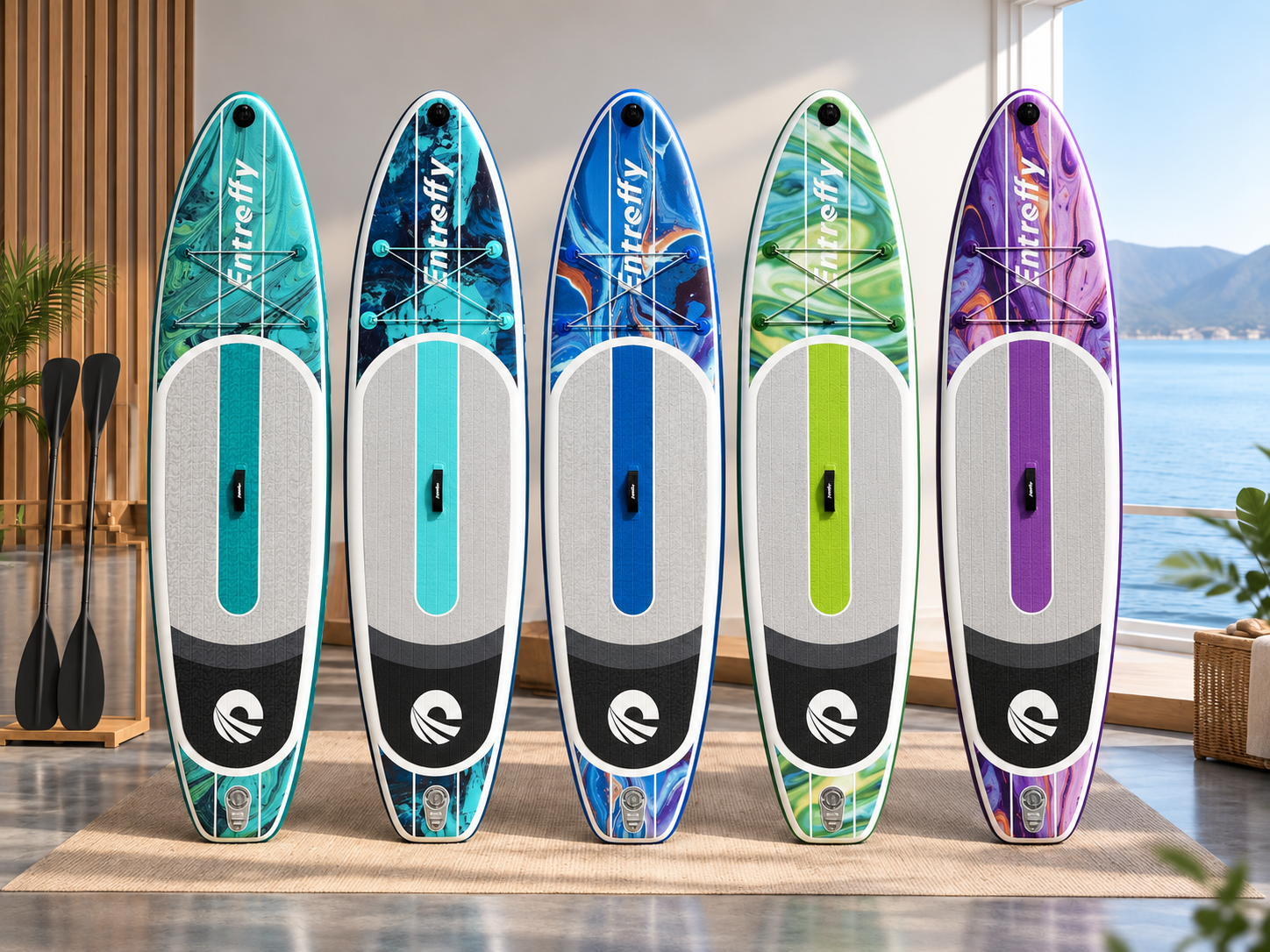
1. Start With Customer Groups, Not Board Colors
One of the easiest ways to create a weak inflatable paddle board range is to begin with graphics.
Blue board.
Green board.
Orange board.
Different artwork does not automatically create different products.
Before choosing designs, identify who each SUP is intended for.
Typical customer groups may include:
First-time paddlers
General recreational users
Touring-oriented paddlers
Families
Larger riders
Fitness users
Rental operators
Customers looking for more specialized use
The exact categories depend on the market.
The important point is that each wholesale inflatable paddle board should have a reason to exist beyond its color.
2. Build the Range Around a Core All-Round SUP
For many paddle board businesses, an all-round inflatable SUP can act as the foundation of the range.
All-round boards are generally positioned around broad recreational use rather than one highly specialized activity.
This makes the category easier to explain to beginners and general consumers.
But even within an all-round range, buyers should think carefully about positioning.
One board might target smaller or lighter recreational paddlers.
Another may provide a larger platform for customers who want more space or stability.
The goal is not to create as many models as possible.
It is to cover meaningful customer differences.
3. Add Touring SUPs for a Different Search and Customer Intent
Touring inflatable paddle boards should not simply be all-round SUPs with different graphics.
Their product positioning is different.
Customers looking for a touring SUP are usually thinking more about:
Tracking
Glide
Longer-distance paddling
Efficiency
Directional performance
That creates a different product story from a general recreational paddle board.
For retailers and distributors, this distinction is valuable because it creates another clear search and sales category.
Instead of two SUPs competing for the same customer, the range now serves two different intentions.
4. Do Not Add a Product Unless You Can Explain Why It Exists
Before adding another wholesale paddle board to the range, ask one question:
Why would a customer choose this model instead of the others?
If the answer is only:
“The graphic looks different,”
the range may already be too repetitive.
A stronger answer might be:
It is easier for a beginner to use.
It is designed around touring.
It offers a larger usable platform.
It targets a different rider group.
It is positioned for a particular activity.
Clear product differentiation also makes website SEO easier.
Each inflatable SUP can target a distinct customer problem and search intent instead of several pages competing around nearly identical keywords.
5. Size Should Support Product Positioning
Length, width, thickness and outline are not just technical specifications.
They help define the role of an inflatable paddle board.
A recreational SUP and touring board may need different proportions because their customers prioritize different things.
That means wholesale buyers should avoid selecting dimensions only because a particular size is common in the market.
Start with the intended user.
Then consider which product characteristics support that positioning.
This creates a more logical SUP collection and makes the differences easier for retailers to communicate.

6. Graphics Should Create a Family, Not Random Products
Once the product structure is clear, visual design becomes much more useful.
A strong inflatable SUP range can contain different graphics while still looking like one brand.
That might involve consistent:
Color strategy
Graphic language
Logo placement
EVA styling
Accessory presentation
Packaging
The boards do not have to look identical.
They should simply look connected.
For private label paddle boards, this is especially important.
A coordinated range can make a new brand appear much more intentional than five unrelated SUP designs placed next to each other.
7. Think About the Complete SUP Package
Wholesale buyers are not only purchasing the paddle board.
Depending on the selected product configuration, the complete package may also include items such as paddles, pumps, fins, leashes, bags or other accessories.
These influence both product positioning and customer expectations.
A recreational entry product and a more premium SUP do not necessarily need exactly the same package.
Buyers should therefore consider:
What the customer actually needs
What the sales channel expects
How the accessories support the product position
How the complete package will be presented
Consistency between the board and its accessories also makes the product feel more complete.
8. Avoid Building Too Many Similar SKUs
More products do not automatically create more sales opportunities.
Too many similar SUPs can create several problems:
More inventory complexity
More artwork to manage
More packaging variations
More forecasting difficulty
More customer confusion
More pressure on stock planning
For a new paddle board brand or retailer, a smaller but clearly differentiated range can sometimes be easier to manage than a large collection with weak product distinctions.
A SUP range can always expand after buyers understand which customer groups respond best.
9. Wholesale Buyers Should Think About Seasonality Early
Stand up paddle boarding is strongly connected to outdoor and warm-weather recreation in many markets.
That means inventory timing matters.
Wholesale buyers should work backward from the period when retailers and consumers need product available—not simply from the day they want to place an order.
Planning also needs to account for:
Product selection
Artwork confirmation
Samples where required
Packaging
Order preparation
Transportation
Local inventory arrival
We do not use one universal lead-time number because different projects and supply arrangements can vary.
The important point is to plan the SUP range before the selling season begins rather than reacting after demand has already started.
10. Wholesale Price Is Only One Part of the Product Decision
Buyers naturally compare prices when sourcing inflatable paddle boards.
But quotations are only meaningful when the products being compared are genuinely similar.
Differences may exist in:
Construction
Board dimensions
Components
Accessories
Graphics
Packaging
Customization
Inspection requirements
Commercial terms
A lower quotation may simply describe a different product.
That is why the approved specification remains one of the most important tools in wholesale SUP sourcing.
11. Build Products Around Search Intent as Well as Users
A modern inflatable paddle board range also needs to work online.
Customers rarely search only for:
“paddle board.”
They may search for:
Inflatable paddle board for beginners
Touring inflatable SUP
Stable paddle board
Paddle board for larger riders
Family SUP
Inflatable SUP for travel
This matters for both product development and SEO.
When different boards address different search intentions, each product page and supporting article can target a clearer group of keywords.
The product structure and website structure begin supporting each other.
12. A Wholesale SUP Range Should Be Easy to Understand
A strong paddle board range should make sense quickly.
Customers should be able to understand:
Who the product is for
What type of paddling it supports
How it differs from another model
Why it belongs in the range
Retailers should be able to explain those differences without needing a long technical presentation.
If every product requires several minutes of explanation before the difference becomes clear, the range may need simplification.
Final Thoughts
Wholesale inflatable paddle board sourcing should begin with product strategy rather than product quantity.
A useful SUP range can combine broad recreational products with selected specialized boards, while keeping each model clearly differentiated.
Customer type, intended use, board proportions, graphics, accessories, packaging and inventory planning should all support the same product position.
For brands, distributors and retailers, this creates a paddle board collection that is easier to sell, easier to market and easier to expand.
Zhengying Outdoor Sports works with buyers on inflatable SUP sourcing and product coordination.
If you are planning a wholesale inflatable paddle board range, share your target market, customer groups and preferred SUP categories to discuss suitable product directions.
Address 732 households, No. 55 Feixian Road, Shinan District, Qingdao City, Shandong Province
E-mail zachary@wassersporte.com

