


Woven vs Knitted Drop Stitch Inflatable SUP: Which Is Better?
Why do some inflatable paddle boards feel noticeably more rigid than others, even when they have similar dimensions and inflation pressures?
The answer is not always the PSI rating.
An inflatable SUP's construction influences how the board responds to weight, movement and paddling forces.
One important part of that construction is the drop-stitch core.
Two terms frequently appear in inflatable paddle board specifications: knitted drop stitch and woven drop stitch.
Both can be used to produce functional inflatable SUPs, but they differ in textile construction and potential performance characteristics.
Understanding these differences helps paddlers compare products and helps OEM buyers select suitable materials for their private label SUP collections.
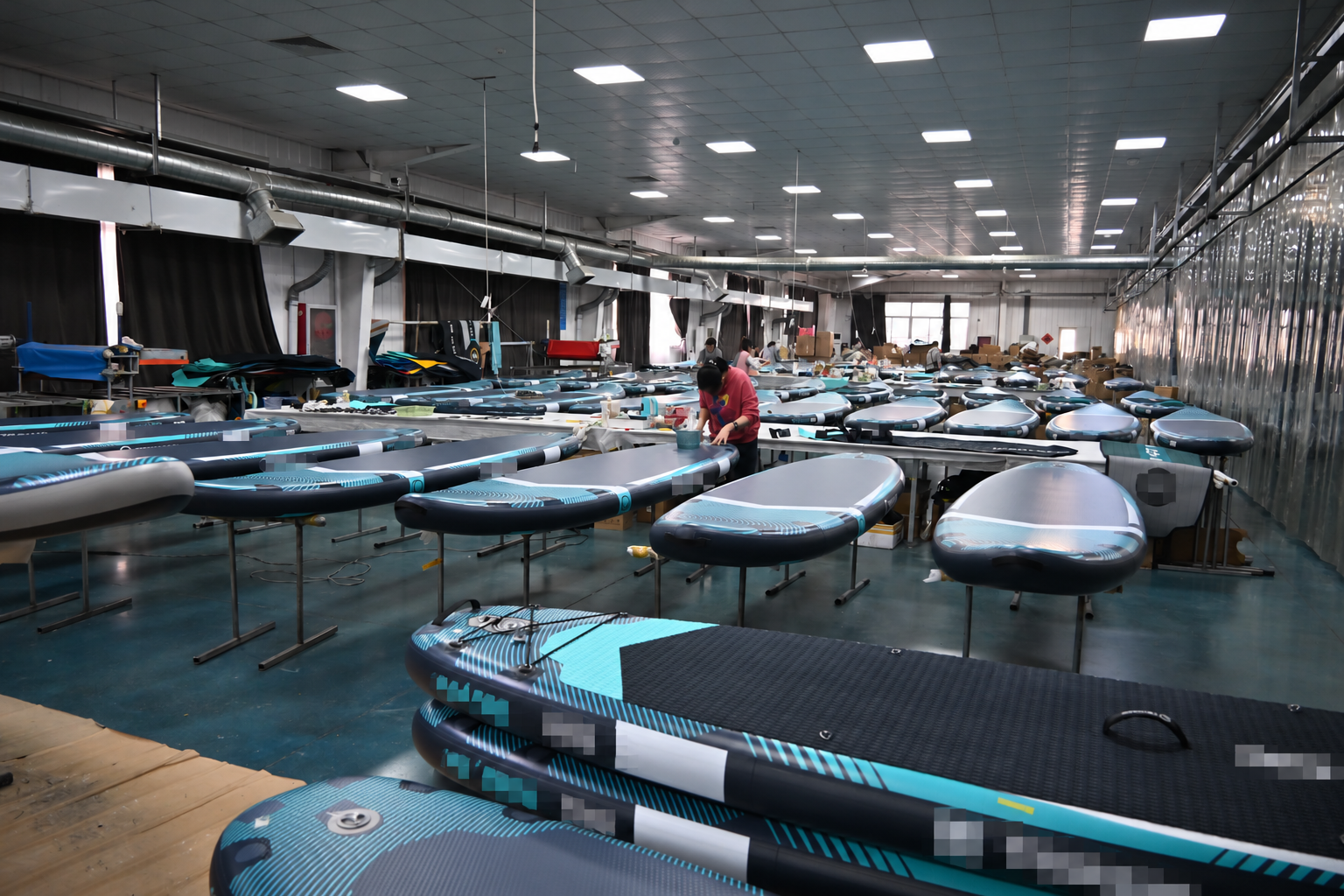
1. What Is Drop Stitch in an Inflatable Paddle Board?
Drop-stitch technology allows an inflatable paddle board to maintain a relatively flat shape under internal air pressure.
The structure uses textile layers connected by numerous internal yarns.
When the SUP is inflated, these connecting yarns help control the distance between its upper and lower surfaces.
Without this structure, the board would not maintain the familiar flat standing platform.
However, drop stitch is not the complete inflatable SUP construction.
The finished board also includes external coatings or laminated materials, sealed rails, valves and other components.
These elements work together to influence rigidity, weight and durability.
That is why two inflatable SUPs using different constructions can behave differently even when their dimensions are similar.
2. What Is Knitted Drop Stitch?
Knitted drop stitch uses a knitted textile structure as part of the internal core material.
Knitted textiles are formed using interconnected yarn loops.
This construction provides a flexible textile base that can be incorporated into an inflatable SUP material system.
Knitted drop stitch is widely associated with established recreational inflatable paddle board construction.
Its potential advantages include mature manufacturing processes and practical material costs.
However, knitted textile structures can exhibit different stretching characteristics from woven alternatives.
Depending on the complete construction, this may influence how the finished inflatable SUP responds to loading.
It is important not to assume that every knitted drop-stitch board has poor rigidity.
A properly designed knitted-core SUP can provide suitable performance for its intended recreational use.
3. What Is Woven Drop Stitch?
Woven drop stitch uses a woven textile structure in the core material.
Woven textiles are generally formed by interlacing yarn systems rather than creating the same interconnected loops used in knitting.
In inflatable SUP applications, woven construction can offer advantages in dimensional stability and stiffness relative to material weight.
This makes it attractive for products where a lighter, more rigid structure is an important design objective.
However, the actual performance depends on the specific fabric, yarn construction, coating and complete board design.
The term "woven" does not automatically identify every internal yarn arrangement.
Manufacturers may use different descriptions for woven and cross-woven systems.
For technical purchasing, buyers should confirm the actual material structure rather than relying only on a marketing label.
4. Woven vs Knitted Drop Stitch: The Main Differences
The most useful comparison involves four factors:
Material structure.
Rigidity.
Weight.
Manufacturing requirements.
Knitted construction uses a knitted textile base and may allow more deformation under certain loading conditions.
Woven construction can provide improved dimensional stability through its textile arrangement.
This may help a manufacturer achieve a favorable balance between rigidity and material weight.
However, these are general material characteristics.
They do not establish the performance of every finished inflatable paddle board.
A high-quality knitted construction and a poorly implemented woven construction should not be treated as equivalent examples.
The complete SUP specification remains essential.
5. Does Woven Drop Stitch Make an Inflatable SUP Stiffer?
Woven drop stitch can contribute to improved rigidity.
However, rigidity depends on more than the internal textile structure.
Other relevant factors include:
Board length.
Board width.
Board thickness.
Material configuration.
Rail construction.
Inflation pressure.
Load distribution.
For example, comparing a shorter recreational SUP with a longer touring model does not isolate the effect of woven construction.
The board outlines and dimensions are already different.
To understand the material difference, compare products with similar geometry and appropriate testing conditions.
A meaningful comparison should examine how much each board bends under a defined load.
The results provide more useful information than simply describing one construction as premium.
6. Is a Woven Drop Stitch SUP Always Lighter?
Not necessarily.
A woven material system may allow weight savings compared with certain traditional constructions.
But the finished inflatable paddle board includes more than its internal core.
Additional PVC layers, reinforcement, rail materials, EVA deck pads and installed components all contribute to total weight.
A woven SUP with substantial reinforcement may weigh more than a knitted SUP using a lighter overall construction.
For this reason, buyers should distinguish between material weight and finished board weight.
If a supplier claims a weight advantage, ask what products or material configurations are being compared.
The comparison should use clearly defined specifications.
7. Does Higher PSI Mean Better Construction?
PSI measures inflation pressure.
It does not independently measure construction quality.
Increasing pressure within the manufacturer's approved range can improve the firmness of an inflatable SUP.
However, the relationship between inflation pressure and rigidity depends on the product.
Two boards inflated to the same pressure may respond differently under the same load.
The maximum permitted pressure also does not prove that one paddle board is superior.
Buyers should consider the recommended operating pressure, the approved maximum and the board's actual behavior during use.
Never exceed the manufacturer's specified pressure limit in an attempt to compensate for inadequate rigidity.
8. Woven Drop Stitch and Fusion Construction Are Not the Same
This distinction is particularly important when comparing inflatable SUP specifications.
Woven and knitted describe aspects of the textile core construction.
Fusion commonly refers to a process used to laminate or bond materials within the board's external structure.
Rail welding or adhesive bonding concerns the assembly of the side connections.
These are related but separate construction decisions.
A manufacturer may combine a woven core with different external laminate configurations.
Likewise, knitted drop stitch can be used within different finished board constructions.
Therefore, a quotation stating "woven fusion SUP" should identify both the core material and the lamination system.
Do not assume that selecting one technology automatically confirms the others.
9. Which Construction Is Better for Recreational SUPs?
For a general recreational inflatable paddle board, suitability depends on the target rider and expected use.
A well-designed knitted-core SUP may provide the stability, rigidity and durability required for casual paddling.
A woven-core construction may be attractive when reduced weight and improved stiffness are priorities.
However, consumers should not judge a board solely by whether it uses woven or knitted material.
Board dimensions, overall construction, rider weight and paddling conditions remain important.
A suitable inflatable SUP is one that performs consistently within its intended operating conditions.
10. What About Touring and Performance Inflatable SUPs?
Touring inflatable paddle boards often place greater emphasis on efficient forward movement and maintaining shape under load.
For these applications, structural rigidity can influence how the board performs during sustained paddling.
Woven drop stitch may provide useful advantages where stiffness relative to weight is a priority.
However, a touring SUP still needs an appropriate outline, thickness, fin configuration and overall construction.
Changing the internal material cannot turn an unsuitable board shape into an efficient touring design.
Product development should begin with the intended paddling performance and then identify the construction that supports it.
11. What Should OEM Buyers Ask Their SUP Supplier?
For OEM and private label inflatable paddle board projects, material selection should be supported by clear specifications.
Buyers should confirm:
Whether the core is knitted or woven.
The specific material construction.
Relevant yarn and textile specifications.
External lamination method.
Rail construction.
Approved operating pressure.
Finished board weight.
Rigidity evaluation requirements.
The supplier should also identify which information is supported by actual product specifications and testing records.
A statement such as "high-density premium woven drop stitch" is not a complete technical specification.
For custom SUP development, documented requirements make it easier to compare quotations and maintain repeat-order consistency.
12. How to Compare Woven and Knitted SUP Samples
Physical sample evaluation is useful when selecting materials for a new inflatable SUP collection.
Where practical, compare boards with the same dimensions, similar overall construction and clearly identified material differences.
Inflate each board according to its approved testing procedure.
Evaluate rigidity using a consistent loading method.
Record the test conditions.
Compare the finished weights using the same measurement method.
When conducting on-water evaluations, consider tracking, glide, stability and the intended rider.
The purpose is to identify meaningful differences between the proposed products.
A comparison becomes less reliable when several construction variables change at the same time.
For private label brands, the approved material and sample specifications should be documented before bulk production.
13. Is Woven Drop Stitch Worth the Additional Cost?
That depends on the product and its intended market.
Woven construction may justify additional cost when its performance characteristics support the target customer.
For a recreational entry-level inflatable SUP, a suitable knitted construction may provide adequate performance.
For a product emphasizing lower weight and rigidity, woven construction may be worth evaluating.
The decision should be based on actual specifications, physical samples and commercial requirements.
Neither material should be selected solely because it sounds more advanced or less expensive.
Frequently Asked Questions
Is woven drop stitch better than knitted drop stitch?
Woven construction can offer advantages in dimensional stability and rigidity relative to weight, but the finished SUP's performance depends on the entire construction.
Can knitted drop stitch be used in a quality inflatable SUP?
Yes. Suitable knitted-core construction can meet the requirements of recreational inflatable paddle boards.
Is woven drop stitch the same as fusion PVC?
No. Woven describes the textile core structure, while fusion refers to a material bonding or lamination process.
Can you identify woven drop stitch from the finished board's appearance?
Not reliably. The internal structure is not necessarily visible, so buyers should confirm the manufacturer's material specifications.
Should private label brands always choose woven construction?
Not automatically. The best choice depends on the intended customer, performance requirements, product specification and available budget.
Final Thoughts
Woven and knitted drop stitch are important parts of inflatable SUP construction, but neither term tells the complete story.
The finished paddle board's performance depends on its internal material, external construction, dimensions, inflation pressure and overall design.
For consumers, understanding these differences helps make product comparisons more meaningful.
For OEM and private label buyers, technical specifications and physical sample evaluation are essential when selecting materials.
The best approach is to choose a construction that supports the intended inflatable SUP rather than relying on a single premium-sounding material label.
Zhengying Outdoor Sports supports inflatable SUP sourcing and custom product development coordination.
If you are developing a wholesale, OEM or private label inflatable paddle board collection, share your target market, preferred board dimensions, construction requirements and estimated quantity to discuss suitable SUP material and sourcing options.
Address 732 households, No. 55 Feixian Road, Shinan District, Qingdao City, Shandong Province
E-mail zachary@wassersporte.com

