


Learning how to use an inflatable paddle board is easier when the first session follows a clear sequence. A beginner does not need to rush directly from the carry bag to standing. Good results come from preparing the board correctly, choosing calm water, starting on the knees and adding one skill at a time.
Search results show broad interest around how to stand up paddle board and paddle boarding for beginners, while inflatable paddle board setup is more product-specific. This guide joins those questions into one routine.
For a first session, select a calm lake, protected bay or another location approved for the exact board. Look for light wind, manageable water temperature and enough shallow space to practice. Check the forecast, current, traffic and local rules before inflating.
Avoid making the first lesson harder with strong offshore wind, breaking waves, fast current or a crowded launch. A wide all-around inflatable SUP can feel stable, but no board removes environmental risk. If conditions change, return to shore early.
Place the deflated board on clean grass, a groundsheet or smooth pebbles. Remove sharp objects first. Unroll the board with the deck facing upward and inspect the valve, rails, seams, fin boxes, carry handle, leash point and cargo bungees. Confirm that the valve pin is in the inflation position described in the product manual.
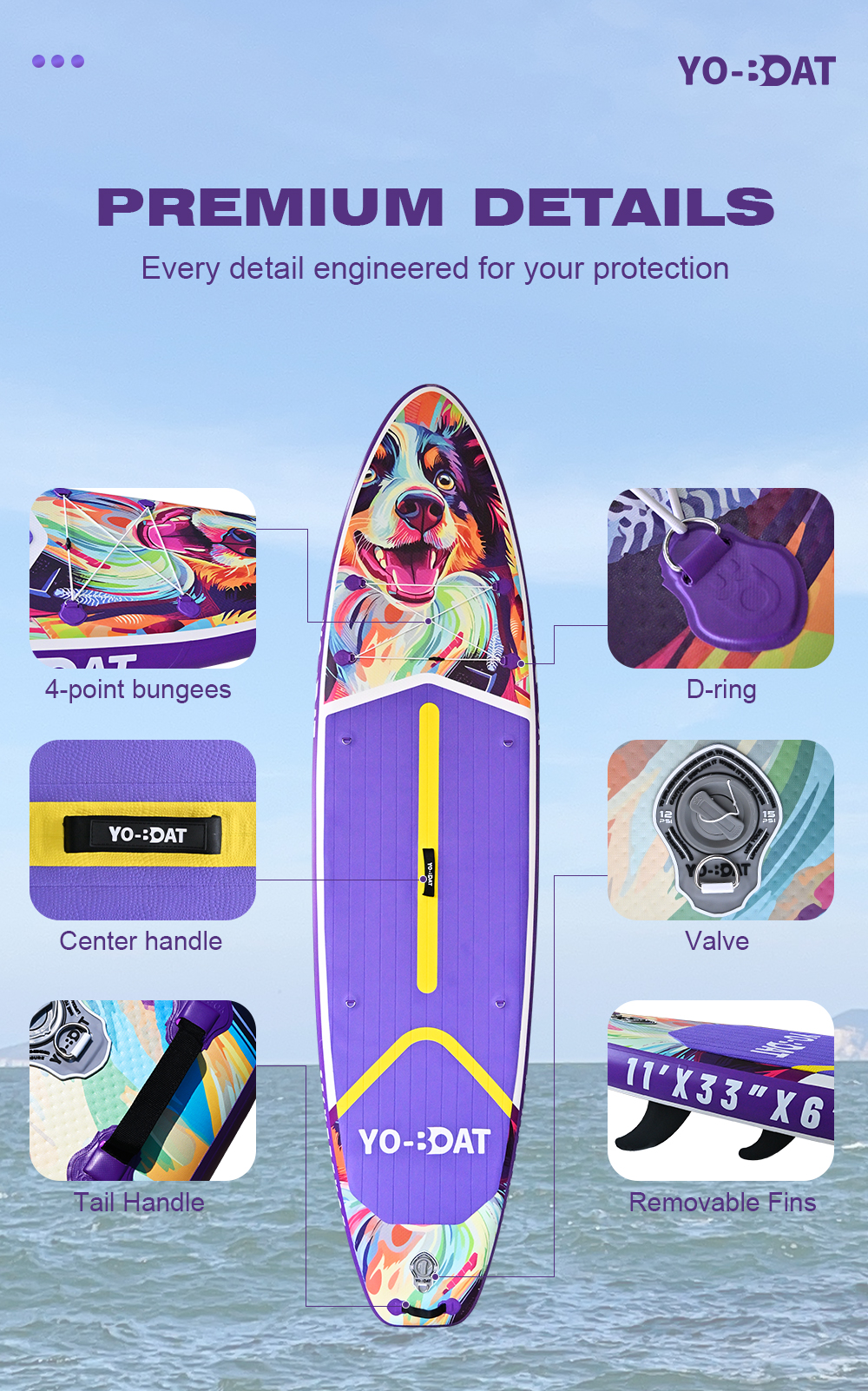
Check the pump hose, gauge, paddle, leash and fins. The supplied 11 ft x 33 in x 6 in model has a Border Collie graphic, purple rails and a broad standing area, but every production model must be checked against its final manual.
Connect the pump hose firmly to the rear valve. If the supplied pump has dual- and single-action modes, follow its instructions as resistance rises. Keep the board flat and watch the gauge near the final pressure.
The supplied product image recommends 12-15 PSI, but users must follow the exact valve label and manual. Under-inflation can make a SUP flex; over-inflation can damage it, especially in heat. Replace the valve cap after disconnecting the hose.
Fit the removable fin according to the supplied system. Confirm it is fully seated and locked, and never drag an installed fin across the ground.
Attach the leash to the designated rear leash point, not to a cargo bungee or carry handle. Leash selection depends on the environment. The American Canoe Association notes that coiled or hybrid leashes can help prevent separation on flat water, while moving water creates snag hazards and requires environment-specific training and quick-release decisions. A leash does not replace a PFD or buoyancy aid.
Assemble and adjust the paddle using the manufacturer's guidance, then tighten every clamp.
Put on the required, correctly fitted PFD or buoyancy aid before entering the water. Carry locally required equipment and tell someone your route and return time.
Rules vary by country and water type. Check the relevant local authority, and consider qualified instruction rather than relying only on an article.
Use the center handle and keep the fin away from obstacles. Do not carry the board by the leash or paddle.
Walk into approximately knee-deep water before placing weight on the deck so the fin has clearance. Hold both rails, climb on from the side and settle on the knees around the center handle. The handle is a useful reference for the balance point. Paddle a short distance on the knees until the water is deep enough to fall safely and the board feels settled.
Place the paddle across the board, put both hands down and move one foot at a time to where the knees were. Keep the feet parallel and about shoulder-width apart on either side of the center handle.
Rise from a low squat. Keep the knees soft, chest lifted and eyes on the horizon. Relax the ankles and allow small movements rather than fighting every ripple.
If standing feels uncertain, return to the knees and repeat. The first objective is controlled balance, not distance or speed.
For the forward stroke, plant the blade ahead of the feet, keep it close to the rail and pull to the feet. Change sides to maintain direction and use the torso rather than only the arms.
For a sweep turn, draw a wide arc away from the board. For reverse or braking, place the blade behind the feet and push it forward. Practice close to shore.
Keep the top hand over the lower hand and avoid hitting the rail. Short, quiet strokes help beginners maintain balance.
Everyone falls while learning. Fall away from the board, protect the head and approach the board from the side near the center. Hold the handle or far rail, kick the legs behind you and slide the chest onto the deck before sitting or kneeling.
Practice reboarding in safe shallow conditions with supervision. Cold water, wind and distance from shore can turn a fall into an emergency.
After use, rinse away salt, mud and vegetation. Remove the fin and leash, then dry the board and accessories before packing.
Open the valve according to the manual without placing the face over it. Roll in the recommended direction, avoid hard creases around the valve and fin boxes, and store the dry kit away from sun, heat and sharp tools. Never leave a fully pressurized board in a hot vehicle.
· stopping inflation before reaching the specified pressure;
· installing the fin incorrectly or launching before the fin has clearance;
· standing too far forward or behind the center handle;
· looking at the feet instead of ahead;
· locking the knees and gripping the paddle too tightly;
· choosing wind or waves that exceed beginner ability;
· treating a leash as a replacement for a PFD;
· storing the board wet or leaving it pressurized in high heat.
Buyers should confirm dimensions, pressure, capacity, fins, pump, paddle, leash, bag, repair instructions and warranty. Brands should also approve artwork, colors, deck layout, packaging and inspection.
OEM and ODM orders can customize color, graphics, size, shape, EVA pattern, bungees, handles, accessories and packaging. Functional changes require drawing review, sample approval and testing.
The best answer to how to use an inflatable paddle board is not a single standing trick. It is a repeatable system: choose easy conditions, inspect and inflate correctly, install the fin and safety equipment, begin on the knees, stand over the balance point, learn controlled strokes and care for the board afterward.
That order reduces frustration and builds confidence. The purple Border Collie design adds visual identity, while the wide platform and portable kit support enjoyable calm-water use.
Yes. We can customize size, color, shape, graphics, EVA pattern, bungees, handles, fins, accessories, packaging and branding. Functional changes require an approved drawing, sample and appropriate testing.
We are an experienced inflatable-products manufacturer with advanced production technology, strict quality control and OEM/ODM support. We provide a one-year warranty against manufacturing defects under agreed terms.
Materials and components are checked on arrival, key processes are inspected during production, and finished products receive full inspection before packing. Checks can cover inflation, air retention, dimensions, appearance, fittings, accessories and packaging.
Follow the exact valve label and manual. The supplied product image shows 12-15 PSI, but the final production model must be confirmed.
Yes. Kneeling near the center handle lowers the center of gravity. Paddle briefly, place the feet where the knees were and rise from a low squat.
Follow local law. A fitted PFD or buoyancy aid and an appropriate leash serve different purposes. Leash type must match flat water, surf or moving water.
Keep the blade close to the rail and finish near the feet. Stay centered and change sides early. Fin installation and pressure also affect tracking.
Rinse, remove the fin, dry every component and pack according to the manual. Store cool and dry, and never leave a fully pressurized SUP in a hot vehicle.
Address 732 households, No. 55 Feixian Road, Shinan District, Qingdao City, Shandong Province
E-mail zachary@wassersporte.com

