


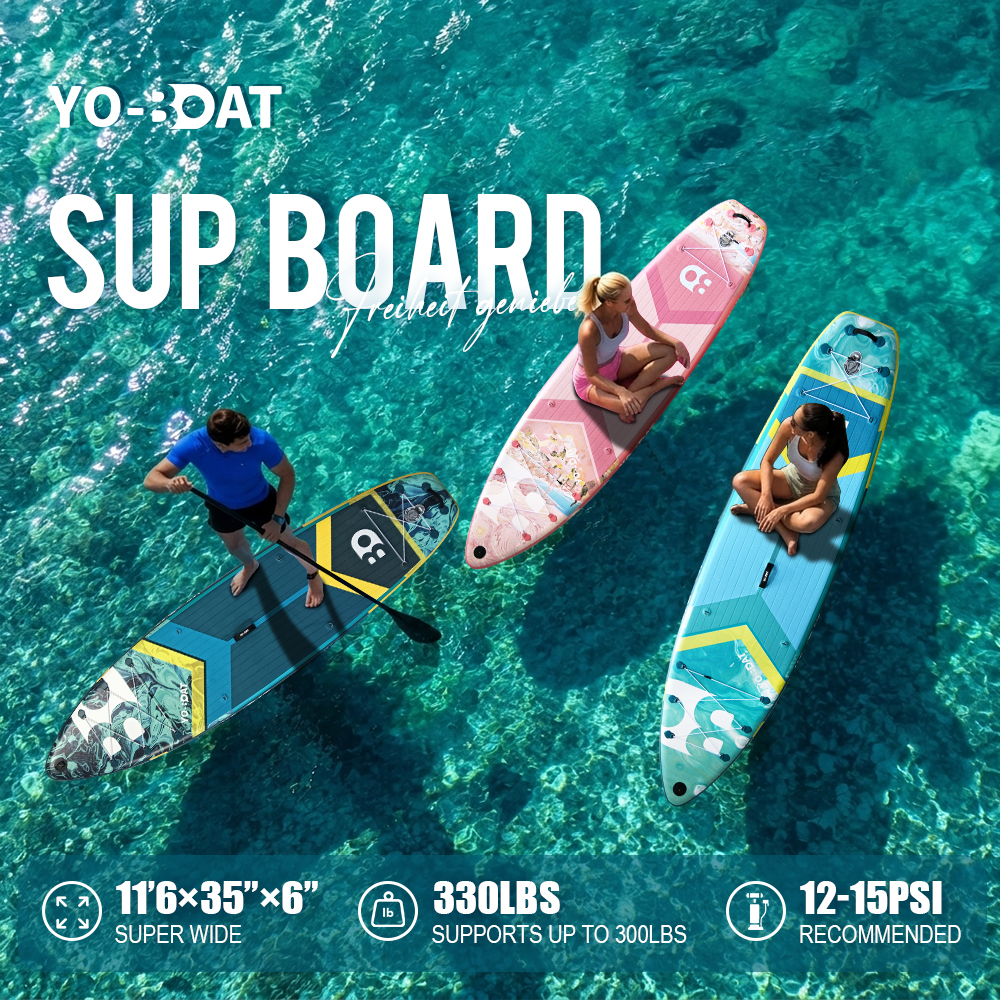
A wide inflatable paddle board answers a different question from a narrow speed-focused SUP. Many buyers want confidence, room for a dry bag, space for a dog or child, or a deck suitable for yoga. That explains why searches such as paddle board for dogs, family paddle board, stable paddle board for beginners and inflatable paddle board for 2 people appear alongside inflatable paddle board.
Width is important, but it is not the only measurement that matters. The board's length, outline, stiffness, pressure, deck layout, fin setup and verified load rating all affect how it feels. A responsible buyer therefore compares the complete system rather than assuming that every wide board can safely carry the same people, pets or equipment.
A broader platform generally gives the paddler more side-to-side room before the rails roll. OutdoorGearLab's 2026 testing connects wider, shorter shapes with stability and mentions yoga and dog use. Width does not remove the need for balance, instruction or suitable conditions.
The supplied YO-BOAT series is shown at 11 ft 6 in x 35 in x 6 in. The long, 35-inch deck can separate the main standing position from a pet, small passenger or dry bag while retaining a pointed nose and fins for recreational tracking.
The trade-off is that an extra-wide board can require a longer reach around the rail and may feel less quick than a narrower touring shape. Buyers should choose width for the actual use case, not because the largest number automatically means the best performance.
The American Kennel Club recommends a wide, sturdy board for paddling with a dog. The dog's experience also depends on grip and usable deck space. A non-slip EVA surface gives paws more traction than exposed PVC, while an open area lets the dog sit or lie down without blocking the paddler's feet.
Before launch, let the dog practise stepping on, sitting and staying calm on the inflated board. Then try shallow, controlled water. Both paddler and dog should use correctly fitted flotation equipment. Bring fresh water, watch deck temperature and never force an anxious animal to continue.
Cargo cords are useful for a compact dry bag, but do not clip a dog to a rigid point on the board. A tether can create entanglement or trapping risk. Pet owners should follow qualified safety advice, local rules and the instructions for their exact equipment.
An inflatable paddle board for 2 people may mean tandem paddling, one adult with a child, or one primary paddler carrying a seated passenger. These are not the same load or balance problem. The final decision must use the manufacturer-approved combined capacity for the exact model, including people, pet, clothing, water and gear.
For a calm-water family session, an experienced adult should remain the primary operator. The passenger can sit or kneel near the center. Everyone must use the required PFD or buoyancy aid and stay close to shore in suitable conditions.
The supplied product artwork refers to two or three people in some scenes, but another capacity graphic uses a different weight figure. Because those references are inconsistent, publish only the final approved specification. A lifestyle image is not a load certificate.
The design has cargo areas at both ends, multiple D-rings, and center and rear handles. Small gear can be secured away from the standing area, leaving the central EVA pad clear.
Distribute weight evenly and keep heavy items low. Do not stack gear high at the nose or cover the valve, handles or leash point. The combined weight must remain within the verified rating. For B2B projects, the number and position of bungees, D-rings, handles and accessory mounts should be approved on a drawing before sampling.
Even a wide board can feel soft when under-inflated. Correct pressure helps the drop-stitch structure hold shape and reduces flex. The supplied artwork states 12-15 PSI, but users must follow the final valve label and manual.
Heat matters. Air pressure can rise when a fully inflated board sits in direct sun or inside a hot vehicle. Never exceed the manufacturer's limit, and do not leave a pressurized board unattended in extreme heat. Before every trip, inspect the valve, seams, rails, fin boxes and attachment points.
The series shows a three-fin configuration. The center fin supports recreational tracking, while the side fins assist directional control. Every fin must be locked before launch.
Carry the board until the water is deep enough for fin clearance. Dragging an installed fin across sand or rocks can damage the fin or box. In shallow locations, buyers should confirm whether an alternative fin is available and whether the approved setup matches the water conditions.
The images show a standard package and an upgraded package that may include a kayak seat and double-bladed paddle. The final quotation should list every item: pump, paddle, leash, fins, bag, repair materials, seat, phone pouch and packaging.
Clear accessory lists reduce returns. Private-label orders can coordinate the bag, pump, paddle, leash, seat, color and packaging, while functional changes require drawing review, sample approval and testing.
· Confirm the exact length, width, thickness and recommended pressure.
· Verify the combined capacity for every rider, pet and item of gear.
· Check the usable EVA deck area and where a dog or passenger will sit.
· Review cargo zones, D-rings, handles, mounts and the designated leash point.
· Confirm the fin system, spare-part availability and shallow-water needs.
· Request a complete accessory and packaging list.
· Check warranty terms, repair guidance and storage instructions.
· For OEM orders, approve artwork, colors, dimensions, layout and inspection criteria before production.
A wide inflatable paddle board can suit families, dogs, beginners, yoga and gear-heavy recreation because it offers a larger working deck. Its value still depends on verified capacity, correct pressure, suitable fins, non-slip coverage, cargo points and responsible safety habits.
The 11'6" x 35" x 6" YO-BOAT series illustrates how one platform can support several market positions and three visual colorways. Buyers should select the package that matches the intended activity, while brands can customize graphics, deck details, accessories and packaging through an approved OEM or ODM process.
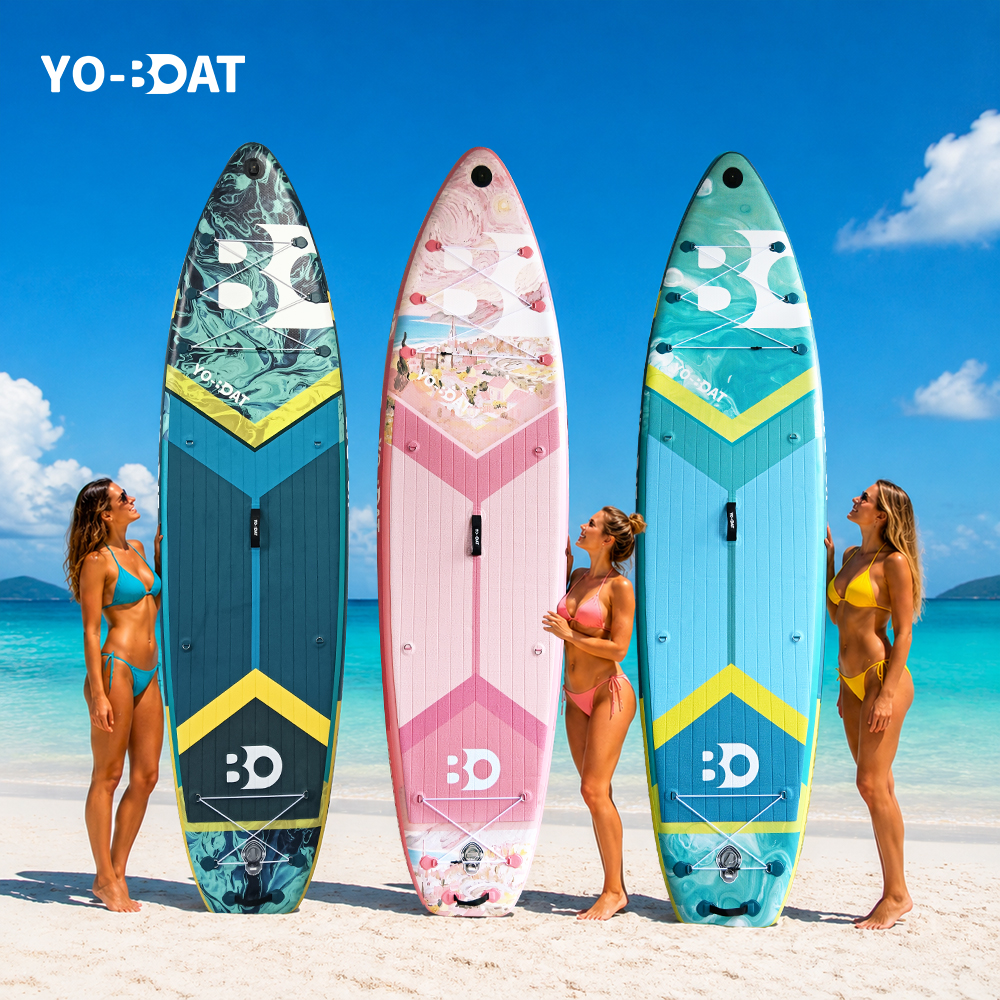
Yes. We can discuss custom size, color, shape, graphics, EVA pattern, bungees, handles, D-rings, fins, accessories, packaging and branding. Functional changes require an approved drawing, sample and appropriate testing.
We are an experienced inflatable-products manufacturer with mature production technology, strict quality control and OEM/ODM support. We provide a one-year warranty against manufacturing defects under the agreed warranty terms.
Materials and components are checked on arrival, key processes are inspected during production, and finished products receive full inspection before packing. The agreed plan can cover inflation, air retention, dimensions, appearance, fittings, accessories and packaging.
The extra width can provide more side-to-side room and may feel reassuring for recreational beginners. Paddlers must still consider length, stiffness, capacity, conditions and their own size and technique.
Yes, when the verified capacity, deck grip, dog training, conditions and safety equipment are suitable. Introduce the dog on land first and use correctly fitted flotation equipment.
Only if the exact model is approved for their combined weight and intended use. Two adults create different balance and space demands from one adult with a child or dog.
Follow the final valve label and manual. The supplied product artwork states 12-15 PSI, but the approved production specification controls.
The supplied references show different accessory combinations, with the upgraded package potentially including a kayak seat and double-bladed paddle. Confirm every included item in the final quotation.
Address 732 households, No. 55 Feixian Road, Shinan District, Qingdao City, Shandong Province
E-mail zachary@wassersporte.com

